Deadlock in Operating System: Definition, Conditions, Examples, Prevention, Avoidance & Recovery
Introduction
In an Operating System, multiple processes run simultaneously and compete for limited system resources such as CPU, memory, files, and I/O devices. Sometimes, a situation arises where a group of processes are unable to proceed because each process is waiting for a resource that is held by another process in the same group. This situation is known as Deadlock.
Deadlock is one of the most important and frequently asked topics in Operating System (OS) for university exams, interviews, and competitive examinations. Understanding deadlock helps students design efficient systems and avoid serious performance problems.
In this article, we will study Deadlock in Operating System in detail, including its definition, necessary conditions, real-life examples, methods for handling deadlock, and important exam points.
This article is specially written for Computer Science students preparing for university exams, GATE, and technical interviews.
What is Deadlock?
A deadlock is a condition in which a set of processes are permanently blocked because each process holds a resource and waits for another resource that is held by some other process.
In simple words: no process can continue execution, and the system comes to a standstill.
Formal Definition
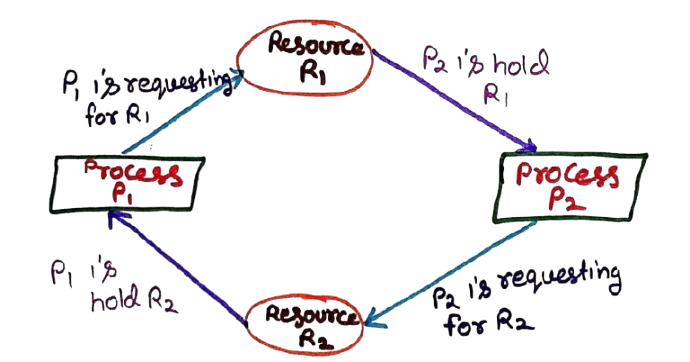
- Process P1 is waiting for a resource held by P2
- Process P2 is waiting for a resource held by P1
As a result, both processes wait forever.
Real-Life Example of Deadlock
- Person A holds a pen and wants a notebook.
- Person B holds a notebook and wants a pen.
Neither person is willing to release the resource they already have. As a result, both keep waiting forever. This is exactly how deadlock happens in an operating system.
Deadlock Example in Operating System
| Process | Holds | Requests |
|---|---|---|
| P1 | R1 | R2 |
| P2 | R2 | R1 |
Both processes are waiting for each other’s resources. Hence, a deadlock occurs.
Necessary Conditions for Deadlock (Coffman Conditions)
1. Mutual Exclusion
At least one resource must be held in a non-shareable mode.
Example: Printer, scanner, file write access.
2. Hold and Wait
A process must be holding at least one resource and waiting to acquire additional resources that are currently held by other processes.
3. No Preemption
Resources cannot be forcibly taken away from a process. A process releases resources only after completing its task.
4. Circular Wait
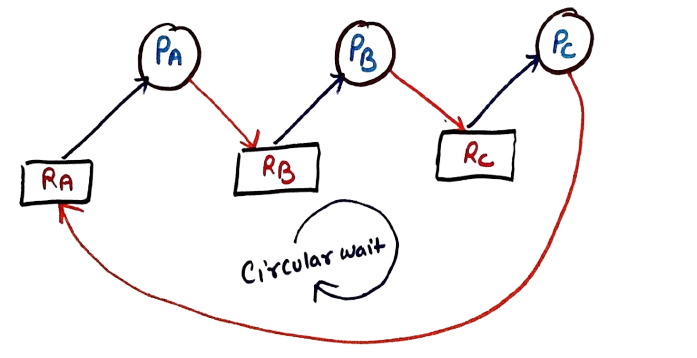
- P1 waits for P2
- P2 waits for P3
- Pn waits for P1
If all four conditions are true, deadlock will definitely occur.
Resource Allocation Graph (RAG)
- Processes – Circles
- Resources – Squares
- Request edge – Process to Resource
- Assignment edge – Resource to Process
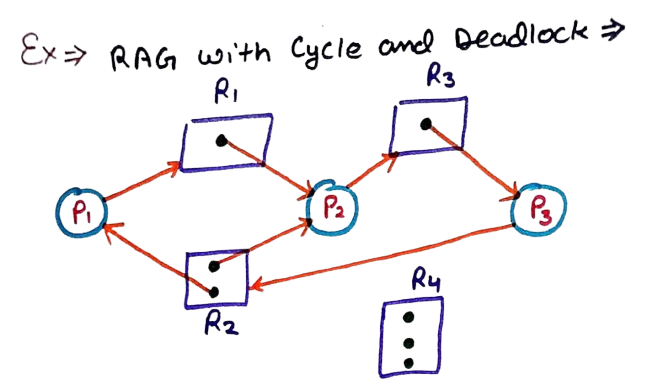
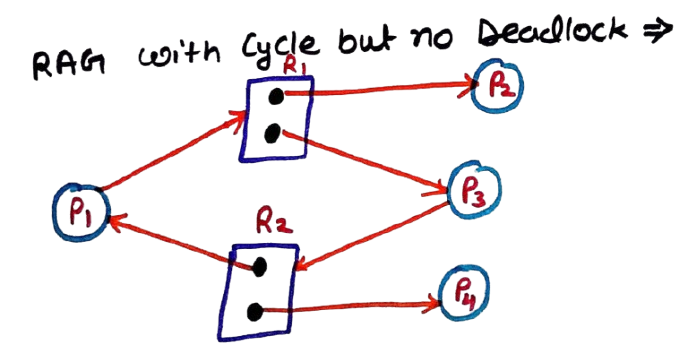
If the resource allocation graph contains a cycle, deadlock may or may not occur.
Methods for Handling Deadlock in Operating System
Deadlock handling is one of the critical responsibilities of an operating system. A deadlock situation arises when a group of processes becomes permanently blocked because each process is waiting for a resource held by another process in the same group. Since none of the processes can proceed, system performance degrades and resources remain locked without doing any useful work.
To manage this problem, operating systems adopt different strategies based on system requirements, complexity, and performance considerations. These strategies range from completely preventing deadlock to deliberately ignoring it. The major methods for handling deadlock are discussed below in detail.
1. Deadlock Prevention
Deadlock prevention is a proactive approach in which the operating system ensures that at least one of the necessary conditions for deadlock never occurs. Since deadlock can only happen when all required conditions are satisfied simultaneously, breaking even one condition guarantees that deadlock will not arise.
In this method, the operating system applies strict rules for resource allocation, which may restrict how processes request and hold resources. Although this ensures safety, it often reduces flexibility and resource utilization.
- Eliminating mutual exclusion: Some resources are designed to be shared wherever possible, reducing exclusive access.
- Preventing hold and wait: Processes must request all required resources at once before execution begins.
- Allowing resource preemption: Resources can be forcibly taken from a process and allocated to another if needed.
- Breaking circular wait: Resources are assigned in a strict global order to avoid circular dependencies.
Advantages
- Guarantees that deadlock will never occur
- Conceptually simple and easy to understand
Disadvantages
- Leads to poor utilization of system resources
- Not suitable for complex or highly dynamic systems
2. Deadlock Avoidance
Deadlock avoidance is a dynamic approach where the operating system carefully examines each resource request before granting it. A request is approved only if allocating the resource keeps the system in a safe state, meaning that all processes can still complete their execution without entering a deadlock.
This method requires the operating system to have prior knowledge about the maximum resource requirements of each process. Using this information, the system continuously analyzes possible future states to ensure safety.
One of the most well-known deadlock avoidance techniques is the Banker’s Algorithm. In this algorithm, processes must declare their maximum resource needs in advance, allowing the operating system to simulate allocations before making actual decisions.
Advantages
- Better resource utilization compared to deadlock prevention
- Ensures deadlock-free execution
Disadvantages
- High computational overhead due to continuous checking
- Requires accurate prior knowledge of resource requirements
3. Deadlock Detection and Recovery
In deadlock detection, the operating system does not try to prevent deadlock in advance. Instead, it allows deadlock to occur and periodically checks the system to determine whether a deadlock has happened. If a deadlock is detected, appropriate recovery actions are taken to restore normal system operation.
Detection mechanisms typically involve analyzing resource allocation information using techniques such as wait-for graphs or resource allocation matrices. These techniques help identify cycles, which indicate deadlock.
Recovery Methods
- Process termination: Terminating one or more deadlocked processes to break the cycle.
- Resource preemption: Temporarily taking resources away from some processes and reallocating them.
- Process rollback: Reverting processes to a safe state and restarting them.
Although this approach provides flexibility, recovery actions can be costly and may lead to loss of computation or inconsistent system states if not handled carefully.
4. Deadlock Ignorance
Deadlock ignorance is a practical approach where the operating system assumes that deadlock is a rare event and chooses not to handle it explicitly. In this method, no special mechanisms are implemented for prevention, avoidance, or detection.
This approach is also known as the Ostrich Algorithm, as the system metaphorically “buries its head in the sand” and ignores the problem. Many general-purpose operating systems adopt this strategy because the cost of handling deadlock may outweigh the benefits in typical usage scenarios.
Advantages
- Very simple to implement
- No performance or computational overhead
Disadvantages
- No automatic solution when deadlock occurs
- System may freeze or require manual intervention
In summary, each deadlock handling method has its own advantages and limitations. The choice of method depends on the system’s design goals, performance requirements, and acceptable level of complexity.
Comparison of Deadlock Handling Methods
| Method | Approach | Overhead |
|---|---|---|
| Prevention | Breaks deadlock conditions | High |
| Avoidance | Checks safe state | Medium |
| Detection | Detects after occurrence | Medium |
| Ignorance | Assumes deadlock never occurs | Low |
Difference Between Deadlock and Starvation
| Basis | Deadlock | Starvation |
|---|---|---|
| Definition | A condition where a group of processes are permanently blocked, each waiting for resources held by others. | A condition where a process is repeatedly denied required resources and waits for an indefinite period. |
| Waiting Time | Processes wait forever and never execute again. | Process waits for a very long time but may execute eventually. |
| Circular Wait | Circular waiting is always present. | Circular waiting does not occur. |
| Nature | Permanent blocking of processes. | Temporary delay caused by unfair scheduling. |
| Resource Allocation | Resources are held by processes and cannot be released. | Resources are continuously allocated to higher-priority processes. |
| Recovery | Difficult to recover without external intervention. | Can be resolved using proper scheduling techniques. |
| Prevention | Prevented using deadlock prevention, avoidance, or detection. | Prevented using aging and fair scheduling policies. |
| Example | Two processes waiting for each other’s locked resources. | Low-priority process never getting CPU time. |
Conclusion
Deadlock is a critical concept in Operating Systems that occurs due to improper resource allocation among competing processes. By understanding deadlock conditions and handling techniques, system designers can build efficient and reliable systems.
Every Computer Science student must clearly understand deadlock, as it is a core topic for exams, interviews, and practical system design.
If you found this article helpful, share it with your classmates and explore other Operating System topics on CSE Gyan.